
Secondary Rhinoplasty - Nose Surgery After a Failed First Surgery
Secondary rhinoplasty is a surgical procedure that involves operating on the patient a second time to correct problems that arose after a failed first rhinoplasty . Therefore, this surgery is often performed by a new specialist surgeon. The problems corrected can be aesthetic or functional . This is the case, for example, if the person has had breathing difficulties since their first rhinoplasty.
When is a rhinoplasty considered a failure?
A rhinoplasty is considered a failure from the patient’s perspective when the result does not meet their expectations. Either the patient had high expectations for the rhinoplasty, or something prevented the surgery and healing from going as planned.
The main cases of secondary rhinoplasty:
- Crooked, deviated, asymmetrical nose, hump on the nose.
- Raised nose, trumpet-shaped, “pig nose”, bridge of the nose too hollow.
- Difficulty breathing through the nose.
- The tip of the nose is hunchbacked, twisted, drooping, misaligned, too thin, too thick.
- Inverted V-shaped nose.
- Crow’s beak nose.
- Skin between the nostrils (columella) that hangs down and is too visible.
Problems can also involve asymmetrical nostrils. One nostril may retract, blocking the nostril opening, or turn up, making the nostril too wide and raised.
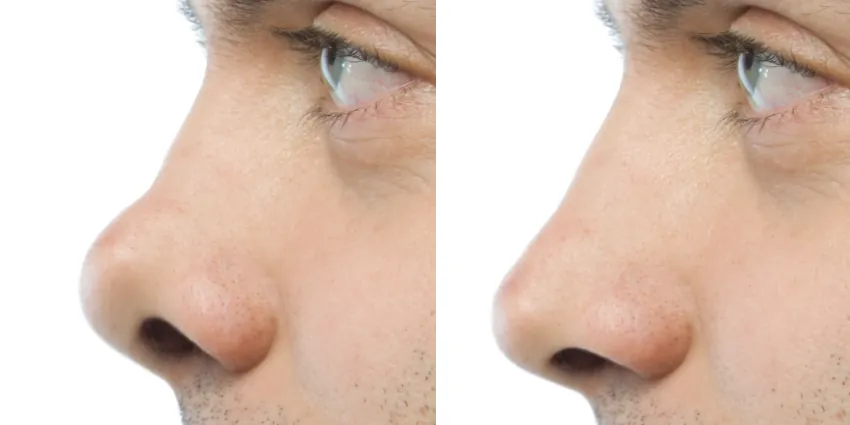

ILLUSTRATION IMAGES
What are the causes of failed rhinoplasty?
The first thing that comes to mind is the surgeon who botched the rhinoplasty or did a poor job. In reality, it’s more complex than that, and there may be many other reasons that don’t depend on the surgeon who performed the initial nose job. The surgeon will always wait at least 12 months after the initial surgery, as changes can still occur during this time.
When the surgeon is at fault:
- The surgeon made a mistake. The operation went badly.
- The surgeon had planned the surgery poorly or had mistaken the choice between thin and thick skin.
When it is not the surgeon’s fault, if the rhinoplasty is botched:
- Rupture of an internal stitch (which holds the cartilage) or external stitch (which closes the skin).
- Poor healing (scar fibrosis, keloid scar, hypertrophic scar).
- The nose has returned to its initial position by shape memory.
- The patient has an accident after the operation. This disrupts the bones and cartilage that had been reworked.
How is secondary rhinoplasty performed?
The procedure for a secondary rhinoplasty is roughly equivalent to the procedure for a primary rhinoplasty . However, the operation is much more complex for surgeons because they will be dealing with scarred tissue and it will be much more difficult for them. In general, they will use the open rhinoplasty method with general anesthesia. The patient will therefore have a small, barely visible scar on the skin separating the two nostrils. The operation will be more extensive and it will be almost essential to spend one or two nights in the hospital. The recovery will be roughly the same as for a primary rhinoplasty, although a little longer.
The difficulty of operating on a nose that has already healed
The surgeon plans his nose job, scrutinizing it, and feeling it extensively. However, he inevitably discovers new things during the procedure. Since the patient was very disappointed by his first operation, the stakes are high for the surgeon performing a secondary rhinoplasty. This second operation must be successful and the patient must be delighted with his new nose.
The need for cartilage grafting
In most cases, the surgeon will need to perform a cartilage graft to reconstruct the nasal cartilage. The cartilage will be taken from inside the nose (septum, the partition between the two nostrils), from the ear, or from a rib. The cartilage harvest may leave small, very discreet scars.
The piece of cartilage will be sculpted and implanted into the nose. A second method involves reducing the harvested cartilage into small pieces and combining it with a tissue envelope. This is the DCF ( Diced Cartilage Fascia) method. The surgeon can then use this preparation like modeling clay. This will be ideal for reconstructing the nasal ridge, for example.
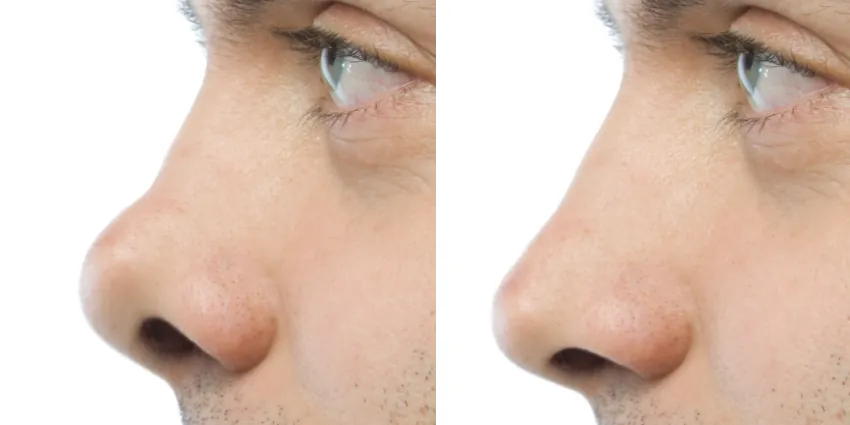
Want to simulate surgery on your nose?
Upload your profile photo and tell us what kind of changes you would like to see on your nose. We will send you a modified photo to show you what it could look like. You can then show the photo to your surgeon to ask if the operation is technically feasible and at what cost.