
What is ultrasonic rhinoplasty?
Many cosmetic and plastic surgeons promote the use of ultrasound devices to operate on their patients. This technology isn’t well known to the general public, and many wonder what ultrasonic rhinoplasty is. We’ll tell you everything!
How does ultrasonic rhinoplasty work?
But what is it? You might think it’s a surgical method that allows you to operate through the skin without incisions… unfortunately, no! Ultrasonic rhinoplasty involves using a machine that uses piezoelectric technology.
What is piezoelectricity?
To simplify, we make ceramic rolls grow and shrink very quickly by sending an electric current through them alternately. This creates a vibration.
How does the surgeon use these piezoelectric vibrations?
The vibrations are transmitted to small tools (inserts) attached to a large pen-like device held in the surgeon’s hand (handpiece). The machine sends electricity to the handpiece, which creates a vibration that is transferred to the insert.
There are several types of inserts. Some are used to cut bones, others to grind, others to peel off membranes on bones… These machines were originally used extensively by dentists.
The handpiece is also equipped with an LED that illuminates the work area and a jet of sterilized water that allows the surgeon to clearly see what he is doing.
This does not change anything regarding all other aspects of nose surgery (anesthesia, scars, etc.). Regarding Before/After rhinoplasty simulations , the use or not of this method has no impact on the simulation.

ILLUSTRATION IMAGES

What are the benefits of ultrasonic rhinoplasty?
More precise cuts and work
Normally, surgeons cut bones (osteotomy) by breaking them with a hammer or cutting them with a burr. The hammer is not always very precise. The burr has the disadvantage of creating heat that can burn bones and tissues. In addition, the cuts are less clean and the burrs attack bones, nerves, skin, and blood vessels as much as possible, so the surgeon is more likely to damage soft tissues that he or she wanted to preserve.
Less swelling, less bleeding and faster recovery
The use of a piezoelectric ultrasound device allows the preservation of soft tissues (skin, gums, blood vessels, nerves, etc.), prevents the bone from being burned, and allows for more precise surgery. This is because the soft tissues will vibrate in contact with the tool but will not be destroyed as can be the case with a burr rotating at very high speed. Since the bone is hard, it cannot vibrate in time with the tool and is therefore cut or scraped. The swelling of the nose after surgery will therefore be less significant and the risk of bleeding lower. By reducing the risk of damaging nerves, surgeons reduce the risk of the patient experiencing temporary or even permanent loss of sensitivity.
Closed rhinoplasties made easier
Typically, surgeons are required to perform open rhinoplasties. This means there is an incision on the columella to turn up the nose (in addition to the incisions in the nostrils) and therefore a small visible scar. Additionally, this type of surgery is more extensive and therefore requires a longer recovery time.
Ultrasonic rhinoplasty allows for some closed rhinoplasty procedures that were previously not possible. Swelling is less severe and recovery is faster for the patient.
What are the disadvantages of piezoelectric surgery?
Surgeons who use the ultrasonic rhinoplasty method often charge higher prices. They justify these prices by explaining that piezo surgery equipment is expensive.
This is both true and false. Indeed, ultrasound surgery equipment is expensive. The basic machine represents a real investment, the inserts (small tools) must be changed frequently, even after each use, and there are consumables. However, for a surgeon who operates frequently, the equipment pays for itself very quickly and easily. This therefore justifies slightly higher costs, but not rates 25 to 50% higher.
Some surgeons criticize ultrasonic rhinoplasty devices for being slower than a milling machine and therefore lengthening the operating time. There is therefore a debate between surgeons who use a milling machine (the old-fashioned way) and those who use the ultrasound machine in addition to the milling machine.
So, now you know what piezo (ultrasound) rhinoplasty is . In short and to simplify, it is a new method that allows bones and cartilage to be cut with micro-vibrations rather than with a rotating milling machine.
Before/After Simulator for Ultrasonic Rhinoplasty
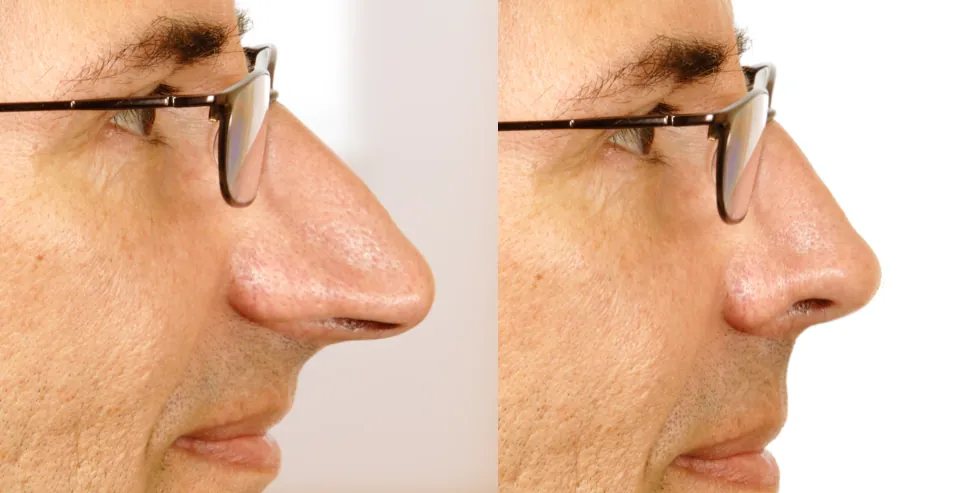
Want to simulate a rhinoplasty ?
Upload your profile photo and tell us what type of changes you’d like to see on your nose. We’ll send you a modified photo to show you what it could look like. You can then show this photo to your surgeon.